How we rebranded a skilled nursing facility in 6 weeks: the Village Place case study
A behind-the-scenes look at the Village Place rebrand. What actually happens when a flooded skilled nursing facility comes back online and needs a brand that fills 104 beds in 4 months. The decisions, the photography, the facility film, the signage, the digital rollout.
A hurricane stripped Village Place down to its bones.
By the time the doors were ready to reopen, the building was beautiful, rebuilt by Legacy United, designed by HHdesigners, every fixture and finish replaced. But it had no recent track record, no story families could trust, and no presence in the market it was returning to.
That’s where we came in. Six weeks later, the brand was deployed across every surface inside and outside the building. Four months after that, the facility was at full census. 104 beds. From a flooded shell.
This is the breakdown of how that actually happened. Not a highlight reel. A walkthrough of the decisions, in order, with the receipts.
If you run a skilled nursing facility coming out of construction, an acquisition, or a relaunch, this is what the work looks like when it’s done well, and why most healthcare rebrands miss what makes the difference.
The starting point: a beautiful building with no posture
A facility coming out of a major rebuild has a specific problem most operators underestimate. The building has changed. The brand hasn’t. The wordmark, the website, the brochures, the signage. All of it was designed for the operation that existed before whatever event triggered the rebuild. After the work is done, the building is unrecognizable. The brand still looks like it belonged to the old version.
For Village Place, the gap was severe. The pre-hurricane building had a brand built for a different era of skilled nursing: clinical, dated, generic. The post-hurricane building was a premium rehab and recovery facility with a sky-mural ceiling in the therapy gym, mid-century interiors, and a level of finish that would have looked at home in a boutique hospitality brand.
We needed to close that gap fast, before the doors opened. A new wordmark wasn’t going to do it. The brand needed a posture, a clear sense of who the operation was now, communicated consistently across eight categories of deliverable, deployed before the first family walked through the door.
What “rebrand” actually meant for Village Place
The word “rebrand” in healthcare gets used to describe everything from a logo refresh to a complete identity overhaul. For Village Place, it meant the latter, plus everything that comes after.
Here’s what shipped, in order:
1. Brand strategy and verbal identity
Before any visual work, we worked with leadership to articulate what the new Village Place actually was. Not what they wanted it to be. What it had become. The post-hurricane facility was operating at a higher standard than the pre-hurricane facility, with new equipment, a new clinical model, and a leadership team that had survived the worst year of their professional lives and chosen to come back. That was the story.
The verbal identity got written first. The wordmark and visual system were designed against that strategic foundation, not the other way around.
2. The wordmark and visual system
The wordmark needed to do three things: read as confident on a building sign that drivers would see at 45 mph, read as warm on a family welcome packet, and read as credible on a one-pager going to a hospital case manager. Three audiences with three different filters.
We landed on a serif wordmark with a custom V monogram, paired with a two-color palette: warm earth and a deep, trustworthy blue. The system was designed to scale across exterior monoliths, business cards, room signage, billboards, and digital surfaces without breaking.
3. Photography: no stock, no exceptions
A facility filling 104 beds in 4 months can’t lean on stock photography. Every image on the new website, in the welcome packet, and in the referral materials was shot on-site after the rebuild. Real lobby. Real therapists. Real residents in real recovery.
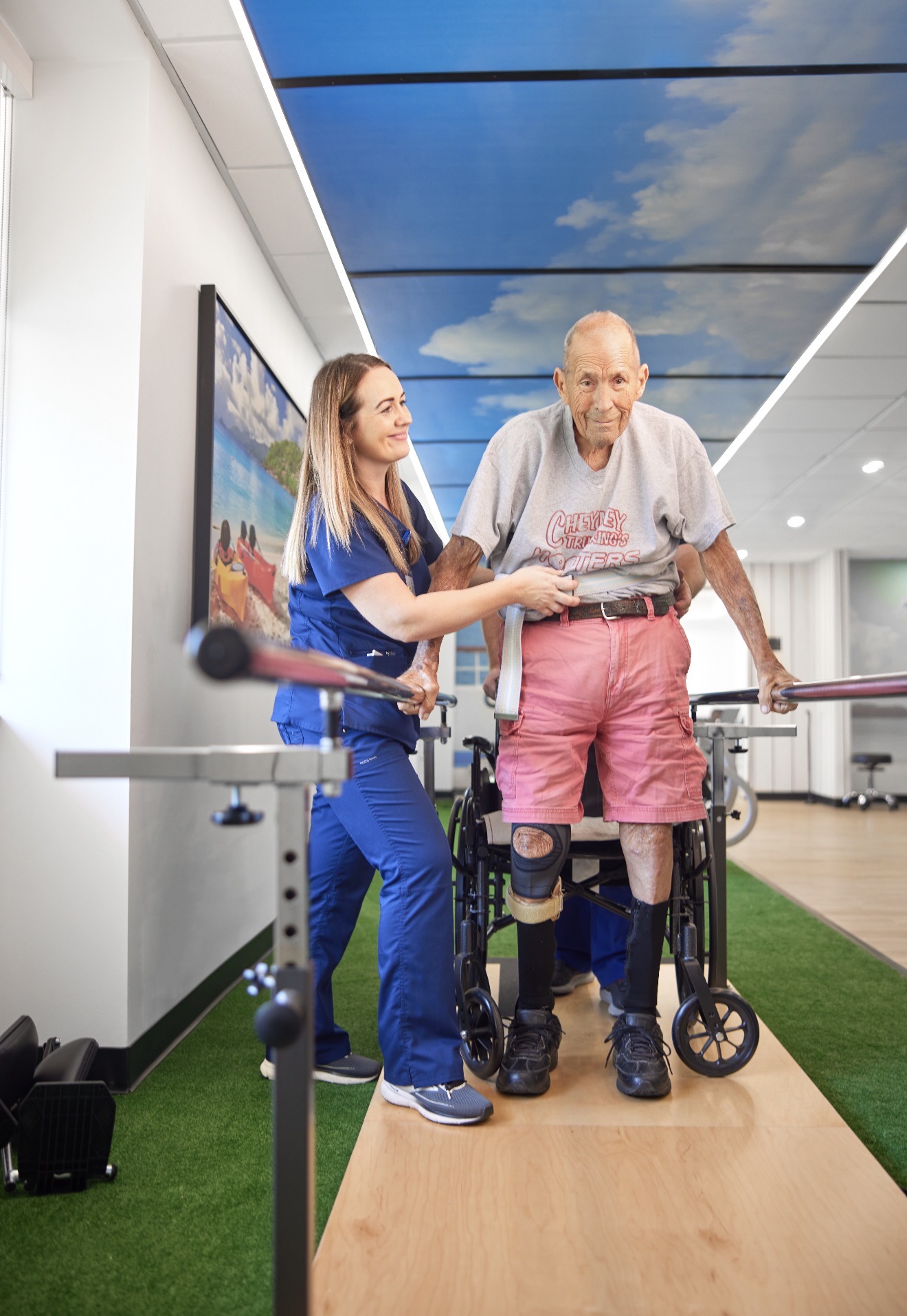
The hero image of the case study (a therapist supporting an amputee resident on the parallel bars under the sky-mural ceiling) was shot in the rehab gym during an actual session. That’s not a setup. That’s what care looks like at Village Place. Stock photography would have undermined the rest of the work.
4. The facility film
This was the single highest-leverage asset in the rollout. Hospital case managers, families, and referral sources all wanted to see the building before they trusted it. The film became the answer.
A skilled nursing facility film, done right, replaces the in-person tour for the 80% of decision-makers who aren’t going to drive out. It’s used in admissions, on the website, in family conversations, and in referral outreach. One asset, deployed across every channel that mattered.
We shot it with Laibel Schwartz Photography, one of the best in healthcare facility film. The film carried the rebrand into every channel that public-facing campaigns alone couldn’t reach.
5. Signage: exterior to interior
Most healthcare rebrands stop at the building’s front sign. Village Place needed every surface coordinated:
- Exterior monolith on Harbor Boulevard, plus a tall blue freestanding marker with the address
- Interior wayfinding through the corridors, with directional cues to physical therapy, the cafe, the boardroom, and amenities
- Resident door signage with wing identifiers and individual room numbers
- “You are welcome, come on in” door hangers for new admissions
A family member walking down the wing for the first time should never wonder if they’re in the right place. That’s what coordinated signage actually does.
6. The on-site experience
The brand didn’t stop at the walls. It lived in the room.
- Welcome card on the bed before the resident arrives, noting the room has been sanitized in anticipation of their stay
- Branded bath set: mat, slippers, waffle towel
- Dining menu on a wood clipboard, sitting on the marble dining surface
- Bath amenities (natural shampoo, soap puck) with the wordmark
- Gift bag and stationery for admissions
- Staff identity badges in two brand colors, with name and role at eye level
The first 30 minutes of a resident’s move-in is when families form 80% of their opinion. Every touchpoint in those 30 minutes was designed.
7. Digital and social
The website families landed on at 11 PM. The Instagram presence hospital case managers checked before referring. The DM flow that answered medical questions in plain language. We ran the brand as a digital operation, not just a building.
8. Out-of-home
The OOH campaign carried the wordmark and brand photography across billboards along the corridors families and referral sources actually drive. This is where most healthcare rebrands skip (billboards feel old-fashioned), but for a relaunching facility in a small Florida market, OOH was how the community learned the doors were back open.
The timeline: 6 weeks of build, then deployment
Most healthcare rebrand timelines assume 12-16 weeks. We ran Village Place in 6 weeks of build, plus parallel deployment across the surfaces above. The compression was possible because of three things:
- Leadership was aligned in writing before any creative started. No re-litigating decisions mid-project.
- The strategic foundation was decided in week 1. Every visual decision after that had a clear filter.
- The team had run this play before. Six healthcare rebrands of similar scale gave us the muscle memory to make decisions fast.
A rebrand timeline isn’t determined by how complex the work is. It’s determined by how many decisions get re-opened. Our job is to keep them closed.
What the work moved
104 beds. Full census in 4 months from a standing start. That’s not the industry baseline. It’s a multiple of it.
A skilled nursing facility coming out of construction typically takes 12-18 months to hit full occupancy. Village Place did it in 4. The brand and the bricks moved together. The rebuild gave us a building worth marketing, and the marketing gave families a reason to walk through the door before any of the comparable facilities in the market.
Joshua, the facility administrator at Village Place, summed it up at the end of the project:
“You can hire someone to make you a logo. We needed someone to understand what we’d just been through, and what our team had carried us through. Mozart got it. They led with our people, not their own work. The building’s full again. The brand reflects the place we actually are.”
That’s the closing line on the case study. It’s also the closing line on this article, because it’s the only metric that matters: the brand reflects the place it actually is.
What this means if you’re an operator looking at a similar moment
If you’re a skilled nursing operator coming out of a hurricane, a renovation, an acquisition, or a leadership transition, the question to ask isn’t “do we need a new logo.” It’s “is there a gap between what this operation has become and how it’s being presented?”
If yes, the work is real. The investment is real. And the result is real.
If no, fix the operation first. A rebrand applied to a fragmented or under-performing operation will look like paint on a broken structure. Families sense it. State surveyors sense it. Staff sense it.
But when the operation has changed and the brand hasn’t caught up. That gap is where the biggest gains in occupancy, recruitment, and referral conversion come from.
That’s what Village Place was. It’s what most of our healthcare rebrands are.
If you want to see the full case study (the photography, the film, the staff portraits, the welcome cards, the signage system, and the testimonial in full), it’s here on the site.
Rebrands like this one run through our skilled nursing marketing practice. And if you’re looking at a relaunch, a rebuild, or a rebrand, we should talk.
Frequently asked questions
- How long does it take to rebrand a skilled nursing facility?
- Most healthcare rebrands take 12-16 weeks of build time. With aligned leadership, a single integrated team, and parallel creative tracks, 6 weeks is achievable. The Village Place rebrand was delivered in 6 weeks of build plus parallel deployment across signage, hospitality, and digital. Timeline is determined by how many decisions get re-opened, not how complex the work is.
- What does a skilled nursing facility rebrand actually include?
- A complete rebrand for a skilled nursing facility includes brand strategy and verbal identity, wordmark and visual system, photography library, facility film, exterior and interior signage, on-site experience design (welcome cards, bath sets, dining menus, gift bags, staff badges), digital and social presence, and out-of-home campaigns. The Village Place project covered all eight categories deployed simultaneously when the facility reopened.
- How much does a healthcare rebrand cost?
- A complete healthcare rebrand for a single skilled nursing facility typically runs $50,000-$150,000 depending on scope, photography production, facility film, signage, and the size of the deployment. The work pays back inside the first census cycle when it's tied to a real operational change.
- What was the result of the Village Place rebrand?
- Village Place filled 104 beds and reached full census in 4 months from a standing start, after a hurricane had taken the facility down to the studs. A typical skilled nursing facility coming out of construction takes 12-18 months to hit full occupancy. The brand and the bricks moved together.
- Who shot the Village Place facility film?
- The Village Place facility film was produced by Laibel Schwartz Photography, one of the strongest specialists in healthcare facility film. Healthcare film is a specialty that requires direction of staff in clinical environments, photography of residents with dignity, and operational sensitivity that generalist videographers don't have.