Real estate development branding: the complete guide for developers
What real estate development branding is, why premium developers should treat it as a strategic discipline rather than a marketing line item, and how to scope, sequence, and evaluate the work across the full lifecycle of a major project.
The branding of a major real estate development is one of the most underestimated value levers in the entire development process. The capital intensity is small relative to the construction budget. The time investment is small relative to the design and entitlement timeline. And the impact on the asset’s terminal value is, in most cases, the highest-leverage marketing decision the developer will make on the entire project.
Yet most premium developments (Manhattan trophy condominiums, Miami branded residences, Los Angeles boutique luxury towers, Aspen and Hamptons resort residential, the major mixed-use projects in markets from Chicago to Dubai) are still being branded the way most developments were branded thirty years ago. A name decided in a meeting. A logo commissioned three months before launch. A website built from a templated platform. A sales gallery furnished by whoever the developer’s last project used. The execution is competent. The strategic thinking that should have come first is absent.
This guide is for developers building real assets at scale who suspect their brand work has been treated as a procurement line item rather than as the strategic discipline it should be. It is the canonical resource we point developers to. It is structured to be read end to end on a long flight, or to be navigated by topic when a specific question is in play.
What real estate development branding is
Real estate development branding is the discipline of building a coherent identity, positioning, and experience system for a real estate asset that aligns the audience the asset is priced for, the architectural and interior reality of the building, the marketing surfaces that introduce the asset to the market, and the operating brand that continues after delivery.
The category includes commercial assets, residential assets, mixed-use assets, hospitality-branded residential, condominium developments, master-planned communities, ground-up assets, and major repositionings of existing buildings. The disciplines are similar. The application differs by asset type, market, and audience.
A coherent definition matters because the term is used loosely in the industry, often interchangeably with real estate marketing. The two are related and distinct. Marketing is the discipline of generating attention and leads for an asset. Branding is the discipline of determining how the asset is perceived once attention has been generated. Marketing without branding produces leads that fail to convert at the price the asset is asking. Branding without marketing produces a brilliantly positioned asset that no one knows exists. Both are necessary. They are not the same.
Why this is a strategic discipline, not a marketing function
There is a structural reason real estate development branding deserves treatment as a strategic discipline at the developer level rather than as a marketing function delegated to a vendor.
The brand decisions on a major asset compound over the entire life of the building. The name appears on signage that lasts decades. The positioning informs the architectural decisions that are physically expensive to revise. The audience definition shapes the program, the unit mix, and the amenity strategy. The first impressions set during pre-launch determine the velocity of leasing or sales. The post-launch operating brand determines the asset’s reputation in its market for the duration of the developer’s hold.
Each of these is a strategic decision with multi-year financial consequences. Treating them as marketing line items in the months before launch routinely produces outcomes that price below the asset’s potential.
Sophisticated developers increasingly recognize this and engage their brand partner alongside the architect, as detailed in our piece on whether to sequence brand-first or building-first. The early engagement is not the only model that works, but it is the model that consistently produces the best outcomes on trophy projects.
The asset categories and what they require
Real estate development branding looks different depending on the asset type, and the differences matter for scoping the engagement correctly.
Trophy and luxury assets
Trophy assets (the major office towers, the prime residential developments in Manhattan, Miami, Los Angeles, and the major international markets, the high-profile mixed-use projects) require a brand engagement that operates at the strategic level from programming forward. The audience is global, the competitive set is the broader category rather than the local market, and the pricing premium the brand work needs to defend is substantial. We have written separately on branding a trophy real estate asset and the specific failure modes that show up consistently in this category.
Branded residences
The fastest-growing category in luxury real estate globally. Hotel-attached residences from Four Seasons, Aman, Mandarin Oriental, Ritz-Carlton, and St. Regis. Standalone hotel-branded residences in markets without an attached hotel. Non-hospitality branded residences attaching fashion and automotive names (Bulgari, Armani, Aston Martin, Porsche, Lamborghini) to towers in Miami, Dubai, New York, London, and Marbella. The brand work in this category is constrained by the master brand partner, sequenced on longer timelines, and consequential at premium-to-unbranded levels of 25 to 40 percent. Our piece on branded residences and how naming and identity work covers the structural decisions developers should understand before entering the category.
High-end residential and luxury condominiums
Premium residential developments at the condo, townhome, and luxury rental level require brand work that operates closer to consumer luxury than to commercial real estate. The audiences are emotional, the consideration cycles are longer, and the brand surfaces extend into hospitality-adjacent territory. Our piece on high-end residential branding covers the discipline at length, and the specific pre-construction marketing program for luxury condominiums is detailed in pre-construction marketing for luxury condominiums.
Commercial office and mixed-use
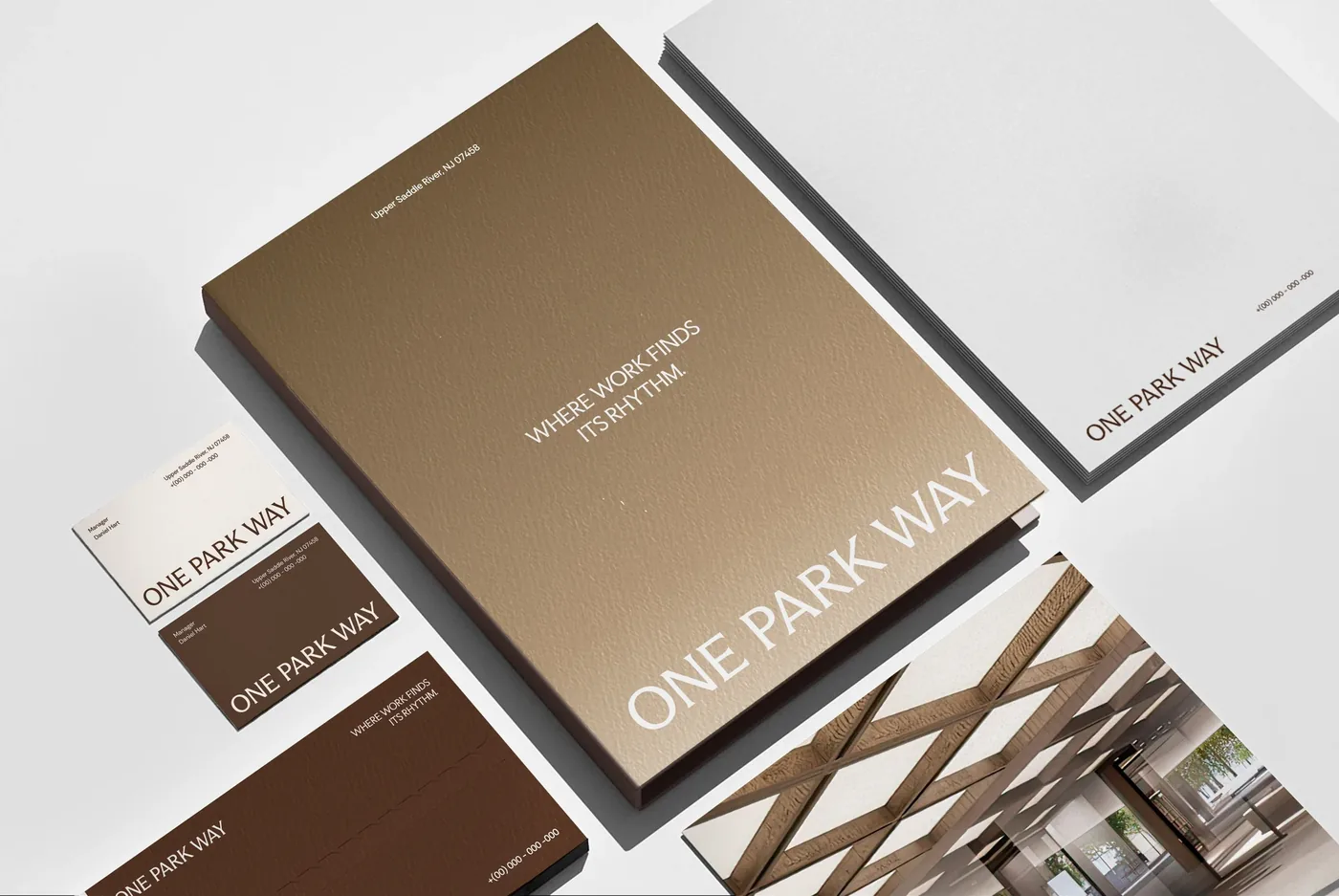
Commercial office assets, particularly in the post-2020 office market, require brand work that addresses both the tenant audience and the broker audience. The tenant decision is increasingly driven by experience, amenity, and design quality, and the brand has to communicate those credibly to the people authorizing the lease. Mixed-use assets layer additional complexity on top of this: the residential, retail, and hospitality components have to read as a coherent composition rather than as separate developments collocated. The One Park Way case study walks through a recent commercial repositioning and the brand work that supported it.
Real estate portfolios
Developers operating multiple assets benefit from portfolio-level brand strategy that establishes a parent brand strong enough to confer reputation premium on individual projects, while preserving the differentiation each asset needs in its local market. The strategic and architectural decisions involved are detailed in our piece on real estate development branding for portfolios.
The components of a complete brand engagement
A properly scoped brand engagement on a major real estate development includes nine components. Each one is a discipline. Each one compounds when handled by the same partner across the full engagement, and decays when fragmented across multiple vendors.
Strategic positioning
The position the asset will occupy in its competitive set, the audience it is priced for, the through-line that connects the architecture, the program, the experience, and the marketing. This is the work that should be done first and revisited least.
Naming and verbal identity
The name of the asset, the verbal hierarchy that supports it, and the language system that the entire marketing program will draw from. The naming work is one of the highest-leverage decisions in the entire development, detailed in our piece on how to name a major real estate development.
Visual identity
The logo, monogram, typographic system, color palette, and visual language that will appear on every surface from the construction barricade to the deed. Visual identity for premium assets needs to function across an unusually wide range of contexts, from a four-foot lobby installation to a small-format social tile.
Signage and wayfinding
Exterior signage, address presence, lobby graphics, building directories, floor identifiers, and the full wayfinding system. This work intersects with the architecture more than any other brand component, which is the structural reason the brand engagement should begin before the architecture is locked.
Pre-launch and leasing or sales website
The digital sales tool that operates from pre-launch through stabilization, designed to qualify and convert prospects in the consideration window. We have written on this at length in the pre-launch leasing site for premium developments. The site is one of the surfaces where templated approaches most consistently underperform the asset.
Sales gallery and physical experience
The on-site sales experience for residential developments, the leasing center for commercial, and the showroom or amenity preview environment more broadly. The physical experience is where the brand becomes three-dimensional, and where the consistency between the brand and the asset is most directly tested by the prospect.
Press, media, and broker engagement
The structured engagement with the trade press, the consumer press, the architectural press, the broker community, and the media relationships that compound across the developer’s portfolio. This is one of the most underbuilt components of most premium developments, and one of the most consequential.
Launch campaign
The integrated marketing program at pre-launch and launch, including the digital advertising, the public relations program, the launch event, the launch materials, and the broker activation. The launch sets the perception that drives the first wave of conversions, and the perception is hard to revise once set.
Post-launch operating brand
The ongoing brand maintenance through lease-up or sell-out and into stabilization. New photography as the building progresses. Updated content as the press cycle develops. Continued press and media engagement. Broker materials that stay current. Most engagements treat this as out of scope and most developers eventually wish they had not.
The economics
The economics of real estate development branding are clearer than most developers assume, and clearer than most brand partners are willing to articulate.
A premium development brand engagement at the trophy level typically lands in a range that is meaningful in absolute terms and small relative to the construction budget. Often it is a fraction of a percent of the all-in project cost. The lift the engagement produces shows up in three places.
The first place is leasing or sales velocity. A well-branded development leases or sells faster than a comparable asset with weaker brand work, which compresses the carry cost of the development and frees the developer’s capital for the next project. The velocity lift is consistent across asset types and is one of the best-documented effects of strong brand work.
The second place is pricing power. A well-branded asset can defend a higher rent or sale price than a comparable asset, because the prospect’s reference point shifts from local comps to the broader category the brand has positioned the asset within. The pricing lift compounds across the entire unit count or rentable square footage.
The third place is exit value. A well-branded asset trades at a different multiple than a poorly branded one, because the institutional capital that values stabilized real estate factors brand strength into the cap rate it is willing to underwrite. This is the largest of the three effects in absolute terms, and the one most developers do not consciously price.
Run honestly, the math on a premium development almost always justifies a brand investment several multiples larger than the developer’s first instinct. Most developers underspend on brand because they are anchored on the marketing budgets of their previous projects rather than on the value the brand work is producing on the asset.
The partner question
The right partner for premium real estate development branding has a specific profile, and the profile does not match the typical agency or marketing firm.
The right partner has done premium development work before, at the asset scale and audience level the project is operating at. This is harder to verify than it sounds, because the field is occupied by adjacent practitioners who can produce a credible-looking pitch deck. The portfolio is the diagnostic.
The right partner treats real estate as a category they understand operationally rather than as one of many categories they accept work in. The strategic decisions on a development involve construction sequencing, leasing timelines, broker dynamics, and capital structure considerations that a generalist partner will not be conversant with.
The right partner is structured for a multi-year engagement rather than a project deliverable. A real estate development brand is a living system that operates from programming through stabilization, and the partner that disengages at delivery leaves the asset under-supported during the period when the brand work is most consequential.
The right partner has opinions on the dimensions outside their immediate scope. Architecture, interiors, signage at the construction level, broker engagement, press strategy. A partner with no opinion on these is a partner whose work will fragment as soon as it leaves their hands.
For developers actively evaluating partners, our 9 questions to ask when choosing a marketing partner covers the diagnostic framework. The framework was written for healthcare originally and translates directly to real estate development.
When to start
The single most consistent piece of advice we give developers is to start the brand work earlier than feels comfortable. The compounding window is long, the brand decisions are low-cost to make early and expensive to revise late, and the architectural and interior decisions that the brand work informs are made well before most developers expect to be thinking about brand.
For ground-up developments, the right time to engage a brand partner is at programming, alongside the architect. For major repositionings, the right time is during diligence, before the acquisition closes, so the brand thesis can inform the underwriting. For pipeline projects in early planning, the right time is now, even before the site is fully assembled.
The math on starting earlier is consistently favorable. The math on starting later is consistently unfavorable. The exception is rare enough that we treat the rule as functionally absolute.
The shorter answer
Real estate development branding is the discipline that determines whether a major asset reaches its full potential or settles in below it. Done seriously, by the right partner, at the right time, it produces outcomes that show up in leasing velocity, pricing power, and exit value at scales that justify multiples of the brand investment. Done as a marketing line item handed to a vendor in the months before launch, it produces a competent set of materials and an asset that quietly underperforms its real estate.
The developers who understand this earlier in their careers compound the advantage across every project they build. The ones who understand it later look at their stabilized portfolio and recognize the projects where the brand work caught up with the asset, and the ones where it did not.
For a working example of the discipline applied to a recent project, the One Park Way case study walks through a Route 17 commercial repositioning where the brand partner and the design team worked in coordination from the start.
To talk about a development in scoping, in design, or in market, inquire. The strategic conversation early is the highest-leverage interaction we have with prospective developer partners, and where we start.
Frequently asked questions
- What is real estate development branding?
- It's the strategic identity work that lets a development sell before the building opens: naming, positioning, visual identity, marketing collateral, the sales gallery experience, and the digital presence that carries pre-sales and leasing. For premium assets, the brand is part of the product.
- What does development branding cost?
- A premium engagement at the trophy level typically lands at a fraction of a percent of the all-in project cost. The lift shows up in achieved pricing, absorption velocity, and the quality of buyer or tenant the project attracts, which is why sophisticated developers scope it as a strategic line, alongside architecture.
- When should a developer start branding?
- Before pre-sales and ideally alongside design development. Naming, positioning, and identity decisions shape the renderings, the sales gallery, and the launch campaign, so starting after the marketing deadline is set means paying rush costs for weaker work.
- What does a complete development brand engagement include?
- Market positioning and naming, visual identity and guidelines, renderings direction, brochure and collateral systems, the project website and digital campaigns, sales gallery and signage design, and launch creative, sequenced against the construction and sales calendar.