How a Route 17 Building Became One Park Way: branding a Bergen County office asset for premium leasing
Inside the rebrand of a Route 17 commercial property in Upper Saddle River, NJ, and what it teaches developers and leasing agents about brand-led repositioning in the Bergen County office market.
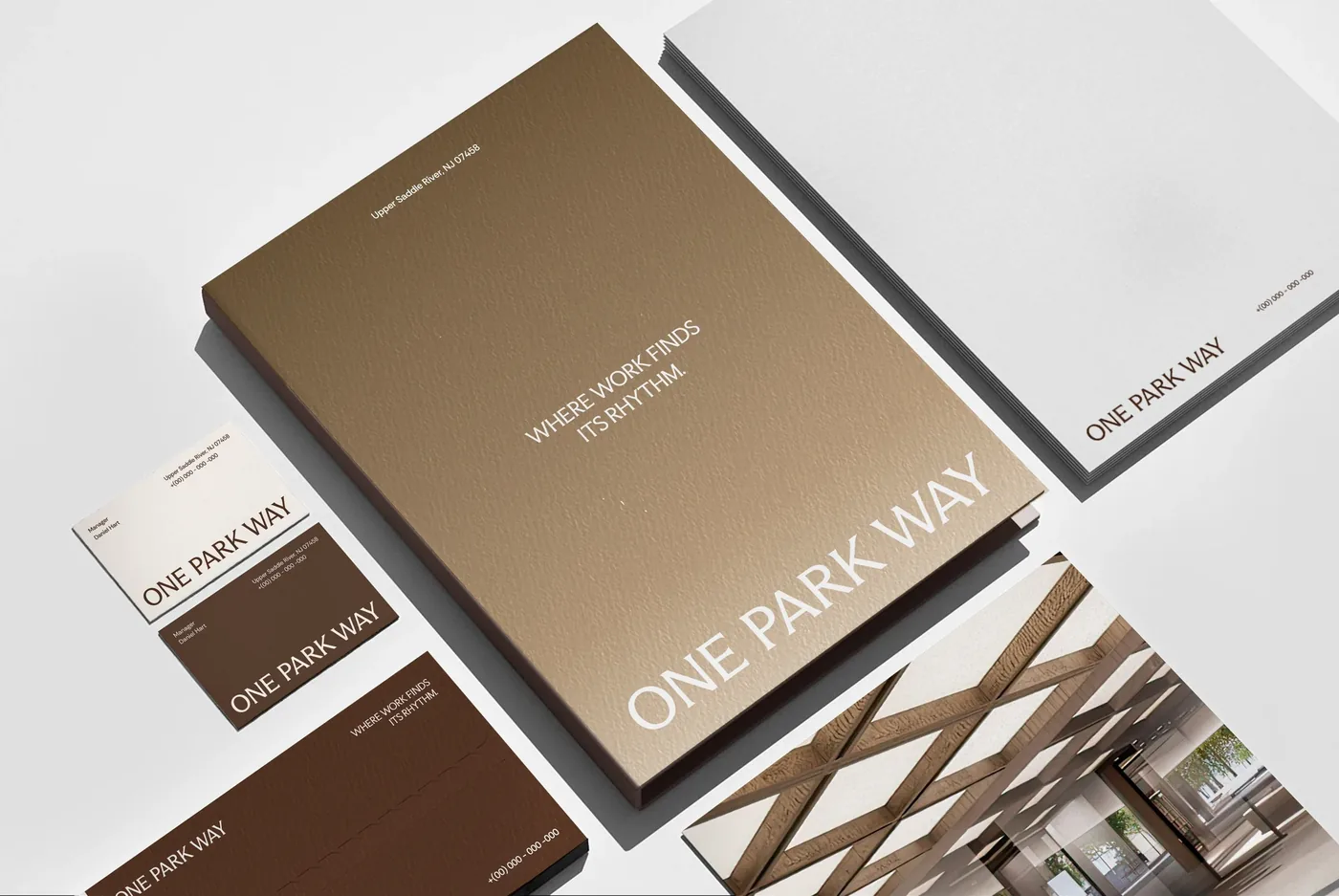
There is a stretch of Route 17 in Upper Saddle River, NJ where the corridor changes character. The traffic thins, the tree line tightens, and the buildings start to look more considered. It is a quieter pocket of one of New Jersey’s busiest commercial spines, and it is where a single asset is being repositioned for a new generation of tenants.
The building has a long history on the corridor. The opportunity is what most Bergen County operators recognize on sight: a structurally sound commercial property with the bones of something premium, but a market identity that had not kept pace with the underlying real estate. The leasing language read like a thousand other Route 17 listings. The signage was utilitarian. The story was missing.
That is the gap brokers and developers know well. A property can be objectively excellent and still trade at a discount because nothing about the way it presents tells the prospective tenant they are looking at a Class A asset. Leasing velocity slows. Concessions creep up. The pro forma starts looking softer than the asset deserves.
This is the story of how that gap got closed, and what it produced.
The repositioning thesis
The mandate from ownership was clear from the first conversation. Take a historic Route 17 building and ready it for the next twenty years of Bergen County office demand. Treat the asset as a brand, not a listing. Build everything from the ground up, name included.
MOZART&CO. came in as the brand and naming partner. HHDesigners, a world-class interior design firm with a portfolio of premium commercial and residential projects, came in for the interior architecture and design. The two teams worked in parallel from week one, which is uncommon in commercial real estate and is exactly why the result reads the way it does.
Most repositionings sequence the work. Construction first, marketing later. By that point, the leasing materials are reverse-engineered to whatever the building ended up looking like, and the brand is layered on top of decisions already made. One Park Way did not work that way. The interior direction and the brand direction informed each other from the start, so the materials, the wayfinding, the signage, the leasing site, and the physical experience all read as one composition.
For brokers walking prospective tenants through the property, that consistency is the difference between a tour that closes and a tour that ends with a polite “we’ll be in touch.”
The name
Naming a commercial real estate asset is a small piece of work that disproportionately affects everything downstream. The street address becomes the identity. The identity becomes the leasing language. The leasing language becomes how the broker pitches it, how the listing reads on LoopNet and CoStar, and how the tenant remembers the building when they describe it to their team.
The work landed on One Park Way.
The reasoning is straightforward. The name reads as singular and definitive. It is short enough to live well in signage and long enough to feel like an address rather than a slogan. It anchors the property to its physical location without leaning on the corridor’s noisier connotations. And it gives the building a sense of arrival, which is what a Route 17 asset needs to compete with the more polished suburbs further west.
For a tenant signing a five or seven year lease, the address on their letterhead matters. One Park Way is an address that looks intentional on a business card. That sounds like a small thing. It is not.
What the brand actually does for leasing value
There is a question worth asking directly, because it is the question every developer and leasing agent is silently asking when an owner spends real money on branding: does this actually move the lease?
The honest answer is that brand alone does not lease a building. Location, price, condition, and tenant fit always come first. But brand is the multiplier on everything else.
Here is what shifts when a Bergen County office asset is properly branded:
The listing reads differently. Brokers have a story to tell instead of a spec sheet to recite. The leasing site converts at a measurably higher rate because the prospective tenant sees the property the way the owner sees it. The signage and wayfinding do half the work of a tour before the tour starts. The asset gets compared against premium peer set comparables instead of against the building next door.
For tenants in the legal, financial services, healthcare, and professional services categories that drive Bergen County office demand, this matters. These are decision-makers who notice details. They sign longer leases when the property feels like the kind of place their clients should see them in.
That is the leasing value that brand creates. It is not theoretical, and it shows up in the rent roll.
The role of HHDesigners
The interior design partnership with HHDesigners is the other half of the story, and it deserves to be named as such.
HHDesigners is one of the design firms operators reach for when the brief is “make this feel premium without making it feel anonymous.” Their portfolio is the reason Route 17 visitors will walk into One Park Way and feel like they are somewhere that has been thought about. The materials, the lighting, the lobby moments, the tenant amenity spaces, all of it is the work of a firm that operates at a level most regional commercial properties never see.
What the MOZART&CO. and HHDesigners pairing produced is rare in commercial real estate. The brand identity does not feel applied. The interior design does not feel decorative. They are the same idea expressed in two mediums, and a tenant touring the property reads them as a single language.
For developers thinking about how to spend a repositioning budget, this is the lesson. Pairing a brand partner with the interior architecture firm at the start of the project, rather than at the end, is what turns a renovation into a repositioning. The cost is not meaningfully higher. The leasing outcome is.
What this means for Bergen County’s office market
Bergen County office product splits roughly into three categories. There is the prestige inventory in places like Hackensack, Paramus, and Rutherford. There is the legacy Route 17 inventory that has not been touched in fifteen years and is being absorbed at heavy discounts. And there is a thin middle band of assets that are quietly being repositioned by owners who understand that the corridor is shifting.
One Park Way sits in that third category, and it is part of a larger pattern. The buildings that get repositioned with intent right now are the buildings that will be quoted at premium rents in 2030. Brokers know this already. Developers are catching up.
For the Route 17 corridor specifically, the buildings that win the next tenant cycle will be the ones that read as deliberate. Tenants are looking at office decisions through a different lens than they were five years ago. A property that signals craft, design discipline, and ownership investment outperforms a property that signals “available square footage” by a wide margin.
This is the brand-led leasing thesis in one sentence: in a softer office market, the buildings with the strongest identity capture the premium tenants, and everything else absorbs the discount.
A note for operators considering the same path
If you are a developer or owner sitting on a Bergen County or Route 17 asset and thinking about a repositioning, the operating principles from One Park Way translate.
Name the asset early. The name affects every line of marketing, every wayfinding decision, and every signage budget. Naming after construction is naming twice.
Pair your brand partner with your interior design firm at the start. The two disciplines either compound on each other or undermine each other. There is no third option.
Treat the leasing site as part of the asset. The leasing site is the second tour every prospective tenant takes. Most of them take it before the in-person tour. The ones who do not convert on the site rarely convert on the floor.
Spend the brand budget on craft, not on volume. A small set of materials done at a premium level outperforms a thick stack of generic collateral every time.
The work
MOZART&CO. led the brand identity, naming, signage and wayfinding system, leasing website, photography direction, and the full applications suite for One Park Way. HHDesigners led the interior architecture and design. The repositioning is live, and the building is leasing.
For developers, brokers, and leasing agents working on Bergen County and Route 17 commercial real estate assets who want to understand what brand-led repositioning looks like in practice, the One Park Way case study lives in our work archive.
To talk about repositioning a property of your own, inquire.
This article is part of a series. The full picture of how brand work compounds across a major real estate development lives in our real estate development branding guide, which is the canonical resource we point developers to.